

AI content provenance is moving from a specialist media topic to a normal business requirement. In 2026, customers, employees, regulators, journalists, and partners are all asking the same practical question: can we prove where this image, document, video, message, or screenshot came from?
The question matters because generative AI has made high-quality synthetic content easy to produce at scale. A polished product photo, an executive quote card, a supplier invoice, a customer-service transcript, or a social video can now be created or altered in minutes. That does not make every AI-assisted file suspicious. It does mean that organizations need better evidence when trust is important. A simple “this is real” statement is no longer enough.
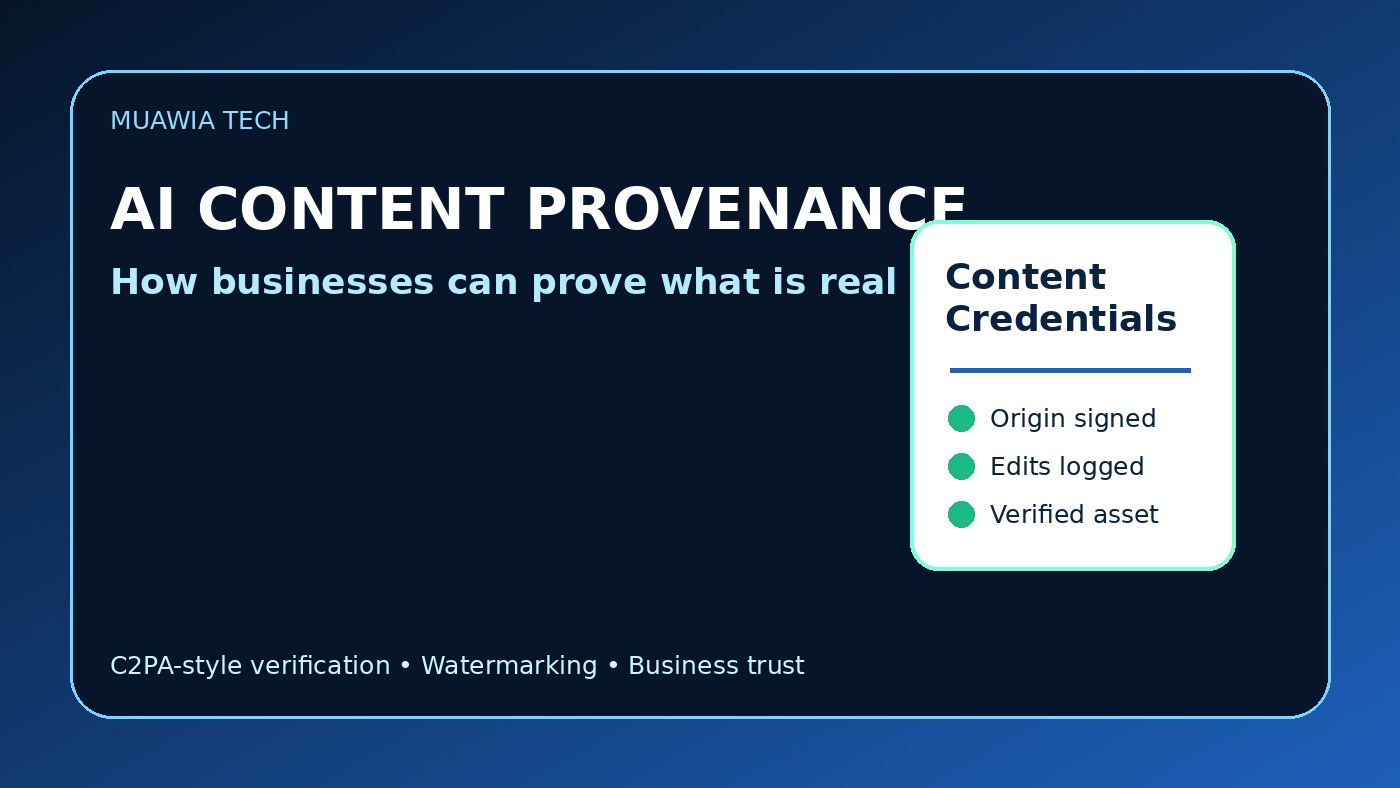
That is why content provenance standards such as C2PA-style Content Credentials are becoming important. They aim to attach verifiable information to digital media: who created it, what tool was used, what edits happened, and whether the file has been changed since a trusted signature was added. Instead of trying to judge authenticity by eye, a viewer can inspect a record of origin and editing history.
Why provenance is trending now
Recent industry moves show that provenance is becoming part of the AI trust stack. OpenAI’s May 2026 update described a multi-layered approach that includes C2PA conformance, more durable watermarking through Google DeepMind’s SynthID, and a preview of public verification tools for checking whether images came from OpenAI systems. The broader Content Authenticity ecosystem has also continued to promote Content Credentials as a way to make digital media easier to verify across platforms and tools.
For businesses, the key point is not one vendor announcement. The key point is that the market is converging on a practical direction: content should increasingly carry evidence about its origin. That evidence may be cryptographic metadata, watermarking, platform labels, audit logs, or internal records. The strongest programs will combine several layers because no single technique solves every authenticity problem.
What AI content provenance actually proves
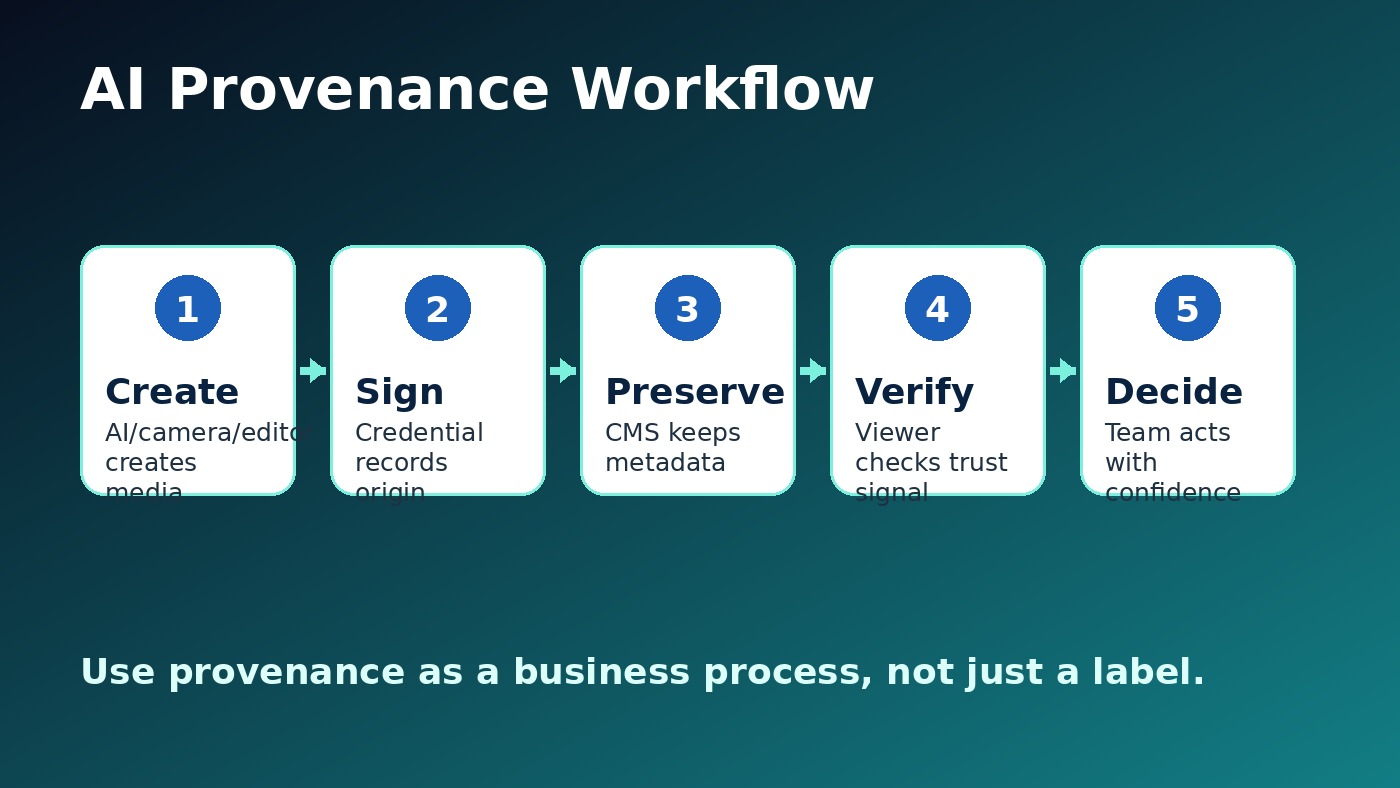
Content provenance is best understood as a chain of custody for digital files. When a camera, editing tool, AI model, publishing platform, or enterprise workflow creates a signed record, it can tell later viewers that a file was created or modified in a particular way. If the file is changed after the signature, verification tools can show that the record no longer matches.
This is different from ordinary metadata. Basic metadata can be stripped or rewritten easily. C2PA-style credentials are designed to be tamper-evident and interoperable, so a verifier can check whether a signed statement still matches the asset. In simple terms, it works more like a sealed label than a casual note.
But provenance is not magic. It does not automatically prove that the content is morally true, legally approved, or free from bias. A verified AI-generated image can still be misleading if it is used in the wrong context. A signed company video can still contain an inaccurate claim. Provenance helps answer “where did this come from and how was it handled?” It does not replace editorial judgment, compliance review, or security awareness.
Where businesses will feel the impact first
The first business use case is brand protection. Marketing teams publish large volumes of images, banners, short videos, product illustrations, and social posts. If attackers can imitate those assets, they can run fake promotions, investment scams, recruitment fraud, or phishing campaigns. Provenance gives companies a way to label official content and teach customers how to verify it.
The second use case is executive and employee impersonation. Deepfake audio and image manipulation already create risk for finance, HR, sales, and public relations. A fake CEO message can pressure staff to transfer funds. A manipulated screenshot can damage reputation. A fabricated “internal memo” can spread quickly. Provenance will not stop every fraud attempt, but it adds a verification step before people trust sensitive media.
The third use case is regulated communication. Financial services, healthcare, education, government contractors, and critical-infrastructure suppliers often need records of who approved what. If AI is used to generate training visuals, patient education, investor materials, or policy explanations, teams may need to show how those assets were created and reviewed. Provenance can support that evidence trail.
The fourth use case is customer support and dispute resolution. Screenshots, chats, voice clips, and transaction documents can become evidence in complaints. As synthetic media improves, organizations will need policies for accepting evidence. A provenance-aware workflow helps staff separate verified company records from untrusted uploads.
A practical implementation model
Businesses should avoid treating AI content provenance as a one-time software purchase. It is better to treat it as a workflow program with clear responsibilities. The starting point is an asset inventory. Which content types create trust, legal, financial, or reputational risk? For many companies, that list includes executive communications, product claims, official logos, press images, customer notices, training materials, and support evidence.
Next, define which assets must carry provenance data. Not every internal draft needs a signed credential. However, public marketing media, executive videos, high-value customer communications, and official product images should move toward stronger authentication. Teams should also define what happens when provenance is missing. Missing credentials should not automatically mean fake, especially while adoption is still growing, but it should trigger caution for sensitive decisions.
Then choose creation and editing tools that preserve credentials where possible. A common failure point is that a file starts with trustworthy provenance and then loses it during resizing, compression, export, or upload. Marketing automation tools, DAM platforms, CMS workflows, and social scheduling software should be tested for whether they preserve, display, or strip authenticity information.
Finally, train staff on verification behavior. A policy is only useful if employees know when to check. Finance teams should verify unusual payment instructions. Communications teams should verify crisis-related media before sharing. HR teams should treat identity documents and recruitment media with care. Customer support teams should know which uploads are accepted as evidence and which require additional confirmation.
Provenance, watermarking, and labels work better together
It is helpful to separate three ideas that are often mixed together. Provenance credentials describe origin and editing history. Watermarks are signals embedded into content that can survive some transformations. Labels are visible or platform-provided notices that tell people content is AI-generated or verified. Each approach has strengths and weaknesses.
Credentials can provide rich detail, but they may be stripped by unsupported platforms. Watermarks can be more durable, but they may not explain the full creation history. Labels are easy for people to see, but they depend on platform rules and user interface choices. A mature authenticity strategy will use all three where appropriate: signed records for important assets, watermarking for AI-generated media, and clear labels or verification instructions for audiences.
Risks and limitations to plan for
The biggest limitation is partial adoption. Provenance becomes more useful as more cameras, AI tools, editors, websites, and platforms support it. Until then, many legitimate files will not carry credentials. Businesses should avoid punishing creators simply because a tool chain is not ready. Instead, use risk-based rules: the more sensitive the decision, the stronger the required evidence.
Another limitation is user education. If customers do not know how to check Content Credentials, the signal may be invisible. Brands should explain verification in simple language, especially for high-risk communications such as job offers, payments, investment information, account recovery, or urgent public notices. A short “How to verify official Muawia Tech content” page is more useful than a hidden technical policy.
There is also a privacy balance. Provenance records should not expose unnecessary personal information about employees, contractors, or customers. Companies need governance around what is signed, what metadata is included, who can view it, and how long records are retained. Authenticity should increase trust without creating new privacy or surveillance problems.
Checklist for leaders
- Identify high-risk content. Start with executive messages, payment instructions, product claims, official images, support evidence, and crisis communications.
- Choose compatible tools. Test whether creation, editing, storage, CMS, and social publishing tools preserve credentials.
- Set verification rules. Decide when missing or broken provenance requires manual confirmation.
- Protect brand assets. Keep official templates, logos, and release channels controlled and auditable.
- Train employees. Teach finance, HR, PR, sales, and support teams how to verify unusual media before acting.
- Explain verification to customers. Publish simple guidance for checking official content and reporting suspicious copies.
- Combine signals. Use credentials, watermarking, platform labels, and internal approval logs together.
What this means for small and mid-sized businesses
Small companies do not need a large authenticity department to begin. They can start with simple controls: restrict who can publish official brand media, keep original files in a managed drive, document when AI tools are used, and add verification steps for sensitive communications. As tools mature, they can adopt Content Credentials in design and publishing workflows.
The near-term goal is not perfection. The goal is to reduce confusion. If a customer sees a suspicious promotion, they should know where to check. If an employee receives a strange payment request, they should know how to verify it. If a partner asks whether an image is official, the company should have a record. Provenance turns authenticity from a guessing game into a process.
The bottom line
AI content provenance will become a normal part of digital trust because the cost of fake or manipulated media is rising. Businesses that wait until a crisis happens will be forced to build verification under pressure. Businesses that start now can create calm, repeatable workflows before customers, auditors, or attackers demand them.
The smartest approach is practical: identify sensitive content, preserve provenance where tools support it, add human verification for high-risk cases, and teach people what signals to trust. In 2026, proving what is real is no longer only a media problem. It is a business resilience problem.
FAQ
What is AI content provenance?
AI content provenance is information that helps verify where digital content came from, how it was created or edited, and whether it has changed since a trusted record was attached.
Is C2PA the same as watermarking?
No. C2PA-style Content Credentials are signed provenance records, while watermarking embeds a signal into content. They can complement each other.
Should every business use content provenance?
Every business should at least assess it for high-risk content such as executive messages, official media, customer notices, and financial instructions.
Can provenance prove that content is true?
No. It can help prove origin and editing history, but factual accuracy still requires review, context, and responsible publishing practices.
For related guidance, see Muawia Tech coverage on Artificial Intelligence, Cybersecurity, and Cloud.