
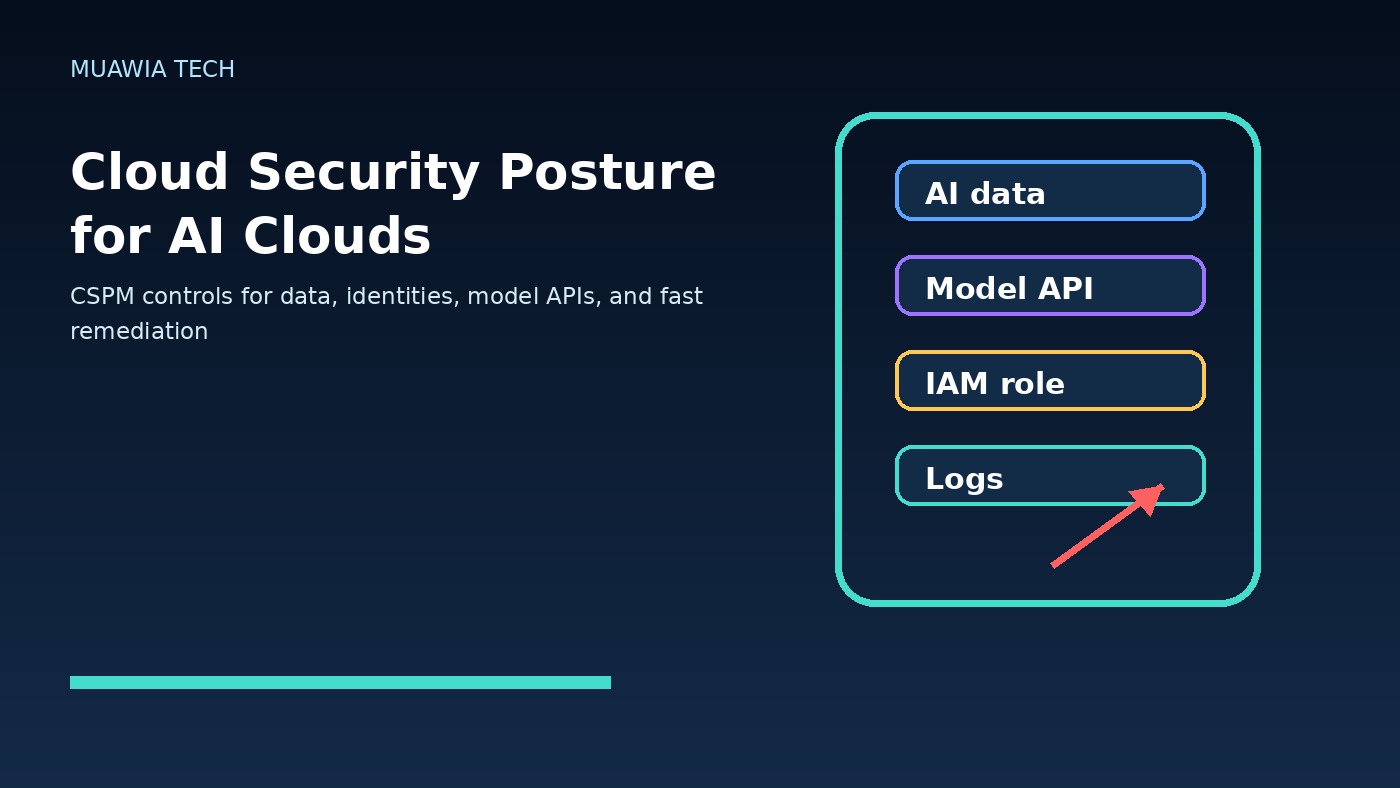
Cloud security posture is changing because cloud environments are now full of AI services, model APIs, vector databases, automated agents, data pipelines, and machine identities. A traditional checklist that only asks whether storage is encrypted or servers are patched is no longer enough. Security teams also need to know which AI workloads can reach sensitive data, which service accounts can call model endpoints, where prompts and outputs are logged, and whether experimental systems have quietly become production risk.
The practical answer is not to slow every AI project. It is to make cloud security posture management, or CSPM, more contextual. In 2026, a useful posture program connects configuration, identity, data classification, runtime exposure, and business ownership. It shows teams which risks could lead to data leakage, model abuse, regulatory exposure, or downtime, then gives them a repeatable way to fix and verify the problem.
This guide focuses on practical CSPM controls for AI-heavy cloud environments. The goal is to help growing teams build a disciplined operating model that supports innovation while reducing preventable cloud risk.
Why AI changes the cloud posture problem
AI systems concentrate risk in new places. A vector database may contain searchable fragments of customer records. A model integration may receive confidential documents. An agent workflow may have permission to read tickets, send email, or update business systems. A data science notebook may hold credentials copied during testing. Each item may look small by itself, but together they create paths that attackers, insiders, or accidental misconfigurations can exploit.
AI also increases the number of non-human identities. Pipelines, agents, connectors, model gateways, serverless functions, and scheduled jobs all need credentials. If those identities are long-lived, over-permissioned, or poorly monitored, they become attractive targets. A strong posture program treats machine identities with the same seriousness as administrator accounts.
Control 1: maintain an AI-aware asset inventory
Start with discovery. Your inventory should include cloud accounts, projects, networks, storage, databases, compute, containers, serverless functions, API gateways, secrets, identity roles, and SaaS integrations. For AI-heavy environments, add model endpoints, vector stores, prompt logs, evaluation datasets, embeddings pipelines, notebook environments, data-labeling tools, and automation agents.
Every asset should have an owner, environment, business purpose, data classification, and lifecycle status. Unowned resources deserve attention because nobody is clearly responsible for patching, access review, logging, or deletion. Temporary AI experiments are especially risky when they remain connected to production data after a proof of concept ends.
Control 2: classify data before it reaches AI workflows
Cloud posture is weak if the organization cannot identify sensitive data. AI workflows often copy, summarize, embed, or transform information, so the original data classification may be lost. Teams should label customer data, regulated records, secrets, source code, financial information, and confidential business documents before they enter model pipelines.
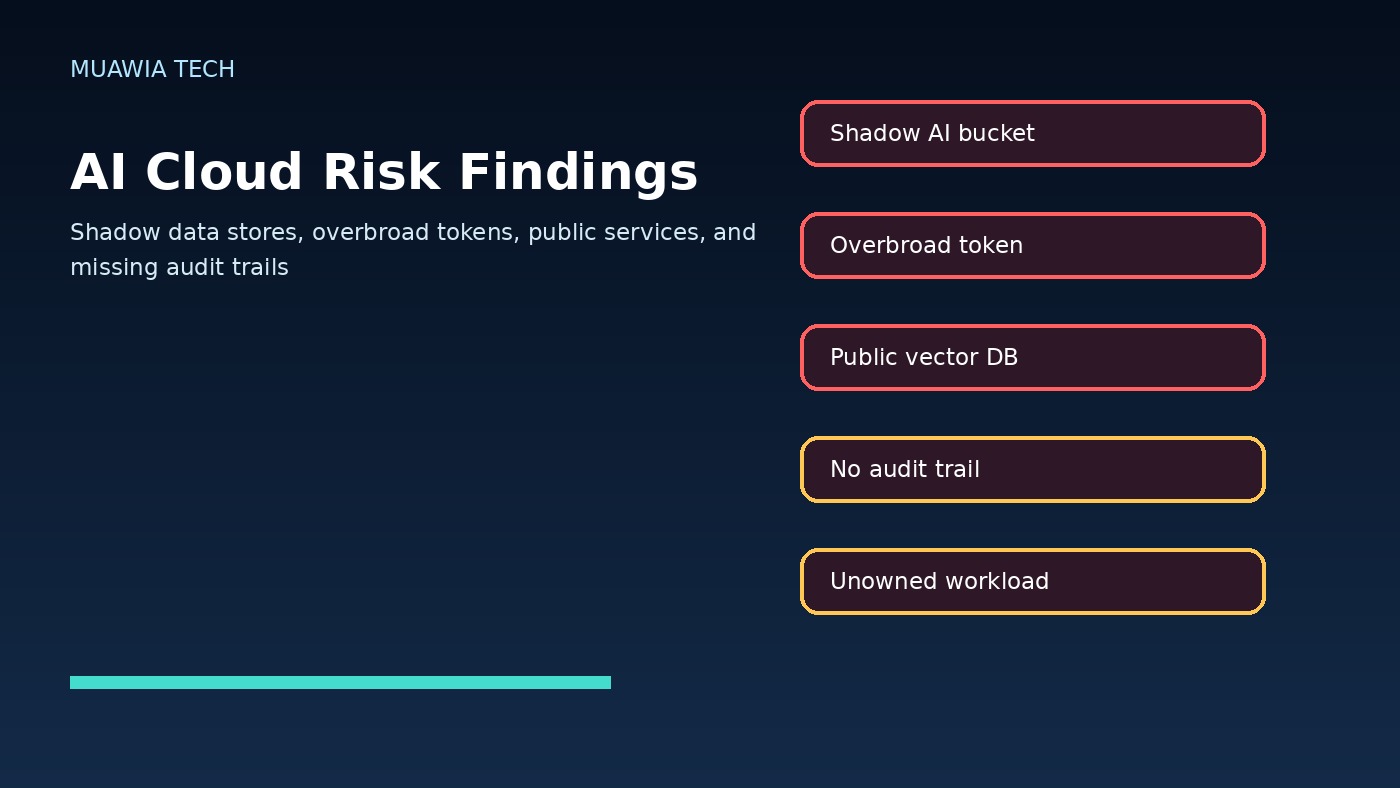
CSPM findings should become more urgent when they involve sensitive data. A public test bucket is a problem; a public bucket containing prompt logs with customer information is an incident waiting to happen. Classification helps security teams prioritize remediation by business impact instead of treating every misconfiguration as equal.
Control 3: reduce excessive machine permissions
Least privilege is one of the most important cloud security posture controls for AI environments. Service accounts should have only the permissions required for a specific workflow. Avoid broad administrator roles, wildcard access to storage, unnecessary cross-account trust, and credentials shared by multiple applications.
Review machine identities for unused permissions and stale keys. Prefer short-lived credentials, workload identity federation, managed identities, and scoped tokens. Where possible, separate read, write, administration, and deployment roles. If an AI connector needs to read a document store, it should not also be able to delete backups, manage identity policies, or export unrelated databases.
Control 4: map AI data paths and exposure points
Security teams need to understand how data moves. Map the path from source systems to staging areas, embedding jobs, model APIs, output stores, analytics dashboards, and user-facing applications. Identify where data leaves your tenant, where it is transformed, where it is logged, and where outputs are retained.
This map does not need to be perfect on day one. Start with the highest-value workflows: customer support automation, document analysis, developer copilots, sales intelligence, fraud detection, or internal search. For each workflow, ask whether data is encrypted, whether access is logged, whether public sharing is blocked, and whether retention rules match the sensitivity of the information.
Control 5: enforce guardrails before deployment
Preventive controls reduce the number of findings that reach production. Infrastructure as code checks can block public storage, unrestricted management ports, missing encryption, disabled logging, weak network rules, and risky identity policies. AI-specific guardrails can require approved model gateways, private endpoints, data-loss prevention controls, and secrets management before a workload goes live.
Policy as code is most valuable when it is tied to developer workflow. Engineers should see a clear reason for a blocked change and a safe example they can copy. If policies are confusing or disconnected from business needs, teams will look for bypasses. Good guardrails make the secure path easier than the unsafe path.
Control 6: monitor drift continuously
Cloud environments drift. Someone opens a firewall rule for troubleshooting, shares a dataset for testing, grants a temporary role, disables logs to reduce cost, or creates a notebook with a copied secret. A monthly review will miss many of these changes. CSPM should monitor meaningful drift continuously and route alerts to the right owner.
Focus alerts on changes that increase exposure: public access enabled, new administrator permissions, disabled logging, new internet-facing services, unencrypted sensitive stores, model endpoints reachable from unexpected networks, or secrets found in code and notebooks. Alert quality matters. Too much noise causes teams to ignore posture data, while contextual alerts create fast remediation.
Control 7: verify remediation with evidence
Closing a ticket is not the same as fixing risk. A posture program should verify that the cloud state changed. If a storage bucket was public, the scanner should confirm that public access is gone. If a role was over-permissioned, permission analysis should show the new scope. If logging was missing, the system should prove that logs are now being collected and retained.
Evidence is useful for audits, but it is also useful for operations. It shows which teams fix risk quickly, which controls keep failing, and which templates or training need improvement. Repeated findings are often process problems, not individual mistakes.
Control 8: connect posture to incident response
AI-related incidents can move quickly because data, automation, and integrations are connected. During an investigation, responders need current answers: which identity accessed the data, which model endpoint was used, whether prompts or outputs were logged, which networks were exposed, and whether any external service received sensitive information.
Posture data should feed incident response playbooks. Run tabletop exercises for public vector databases, compromised service tokens, accidental prompt-log exposure, model API abuse, and malicious automation agents. These scenarios test whether inventory, identity, logging, backups, legal review, and communications work together under pressure.
Metrics leaders should review
Executives do not need every raw finding, but they do need clear indicators. Useful metrics include percentage of AI cloud assets with owners, high-risk public exposures, sensitive stores without approved access controls, machine identities with excessive permissions, critical findings older than target, logging coverage for AI workflows, and mean time to remediate posture issues.
Trend is more important than a single score. Is the number of unowned AI assets decreasing? Are machine permissions becoming narrower? Are public exposure exceptions expiring? Are new AI deployments more secure by default? These questions show whether posture is improving in real operating terms.
Leaders should also ask whether posture data is influencing real decisions. If a team keeps launching workloads without owners, funding may be needed for platform automation. If critical findings stay open because application teams lack time, risk acceptance should be explicit rather than hidden in a backlog. A useful posture program turns technical visibility into accountable business choices.
FAQ
Is CSPM enough for AI cloud security?
CSPM is a strong foundation, but AI-heavy environments also need identity governance, data classification, secrets management, model access controls, monitoring, and incident response playbooks.
What should teams fix first?
Prioritize exposed sensitive data, public model or vector database endpoints, over-permissioned machine identities, missing logs on critical workflows, and unowned resources connected to production systems.
How often should AI cloud posture be reviewed?
High-risk environments should be monitored continuously. Leadership can review trends monthly, while engineering teams should receive actionable findings during normal deployment and operations work.
Conclusion
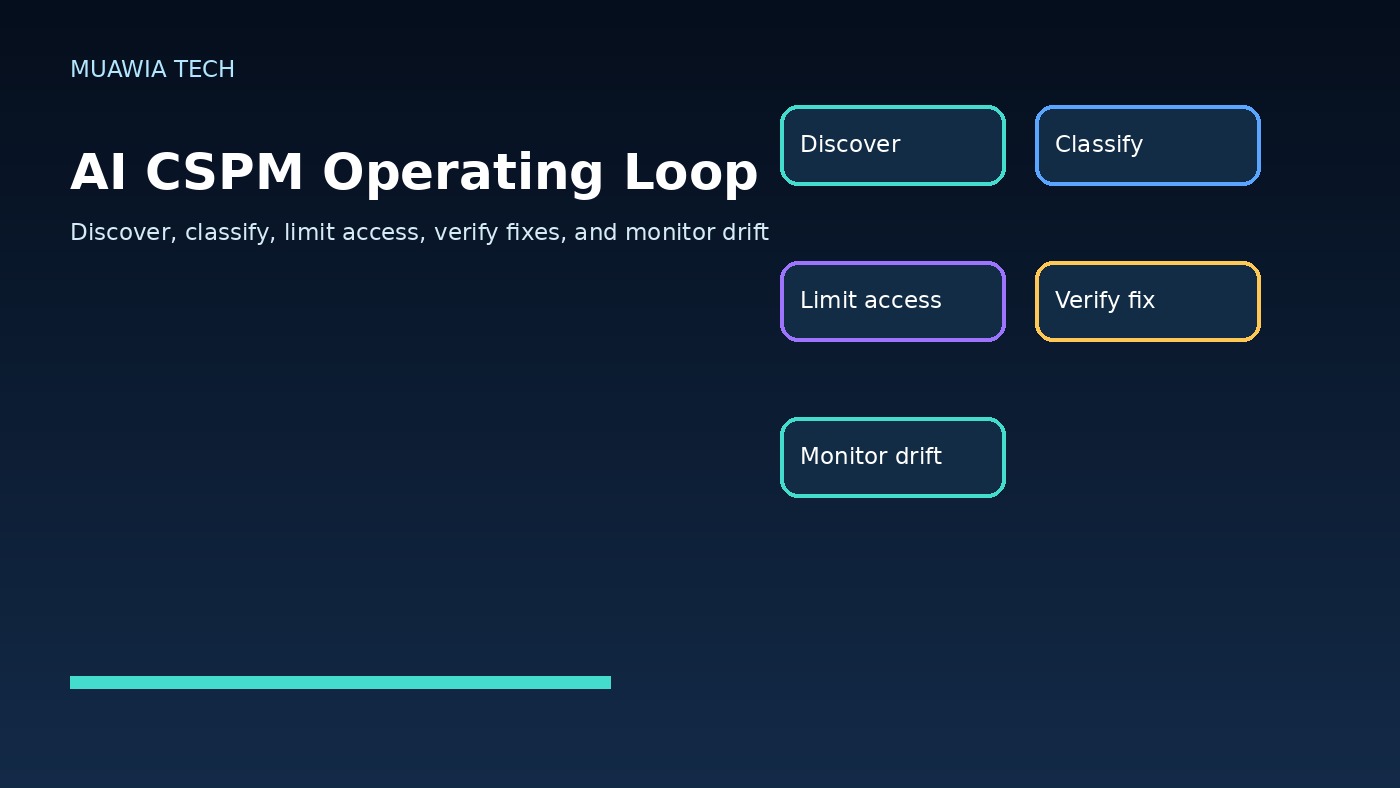
Cloud security posture for AI-heavy environments is not a one-time audit. It is a continuous operating model that discovers assets, classifies data, limits identity permissions, monitors drift, verifies fixes, and prepares teams for incidents. Businesses that build these CSPM controls early can adopt AI faster without leaving sensitive data, powerful machine identities, and model workflows exposed to avoidable risk.
For related guidance, continue with Muawia Tech coverage on cloud security, cybersecurity, and artificial intelligence.
Related update: Cloud and SaaS Resilience in 2026: How Businesses Can Survive Outages, Ransomware, and Vendor Risk.