
Identity security has become one of the most important security disciplines for modern businesses. In 2026, the question is no longer only “who can log in?” The better question is: which people, SaaS apps, cloud roles, API keys, service accounts, automations, and AI agents can touch sensitive systems or data, and can the business prove that access is necessary, monitored, and reversible?
That shift matters because many attacks now begin with identity rather than malware. A stolen session cookie, reused password, excessive OAuth consent, exposed access key, dormant administrator account, or over-permissioned workload identity can give an attacker a path into email, documents, cloud consoles, customer databases, code repositories, and AI tools. Strong identity security reduces that path before it becomes a breach.
This guide explains a practical identity security model for businesses that depend on SaaS, cloud infrastructure, and AI workflows. It focuses on controls that improve visibility, reduce unnecessary privilege, and make access decisions easier to audit without slowing every team down.
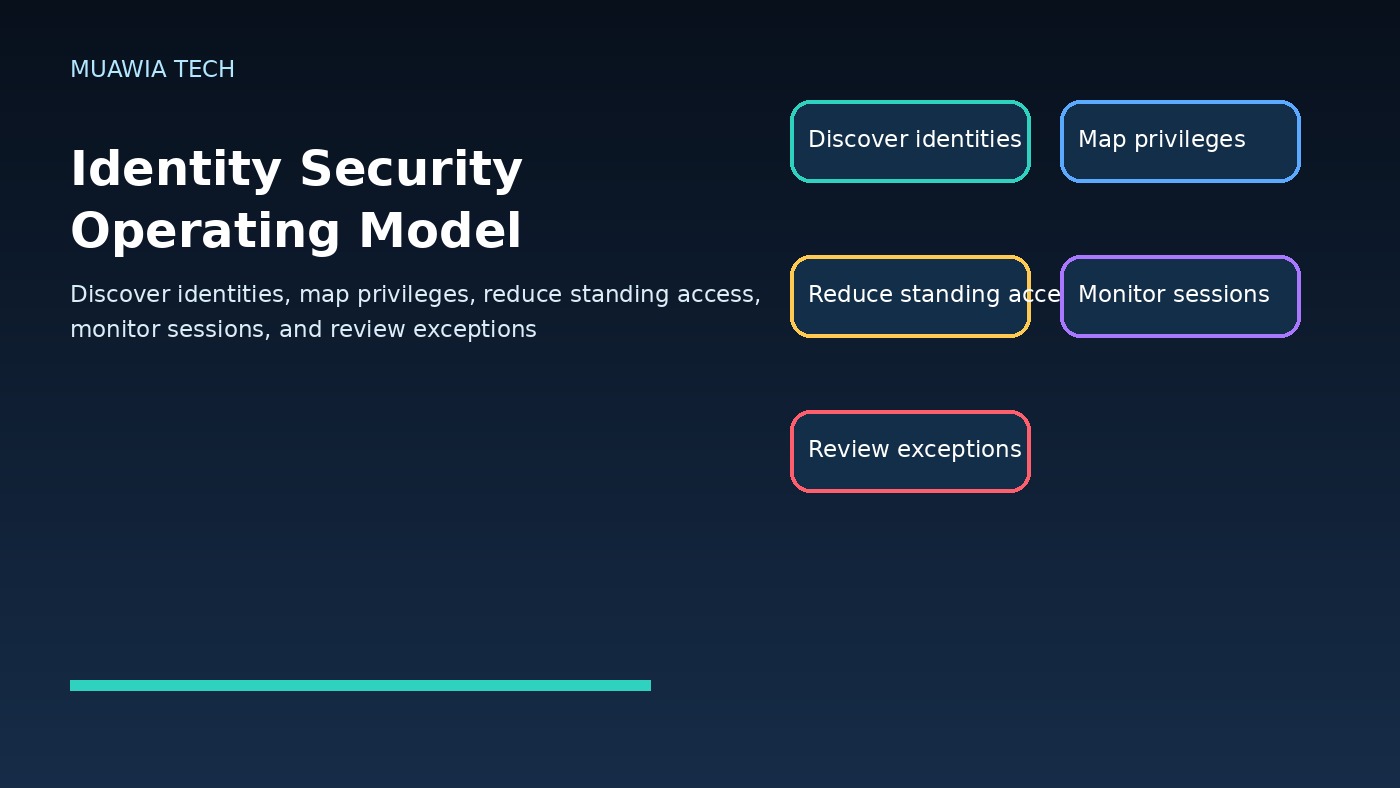
What identity security means now
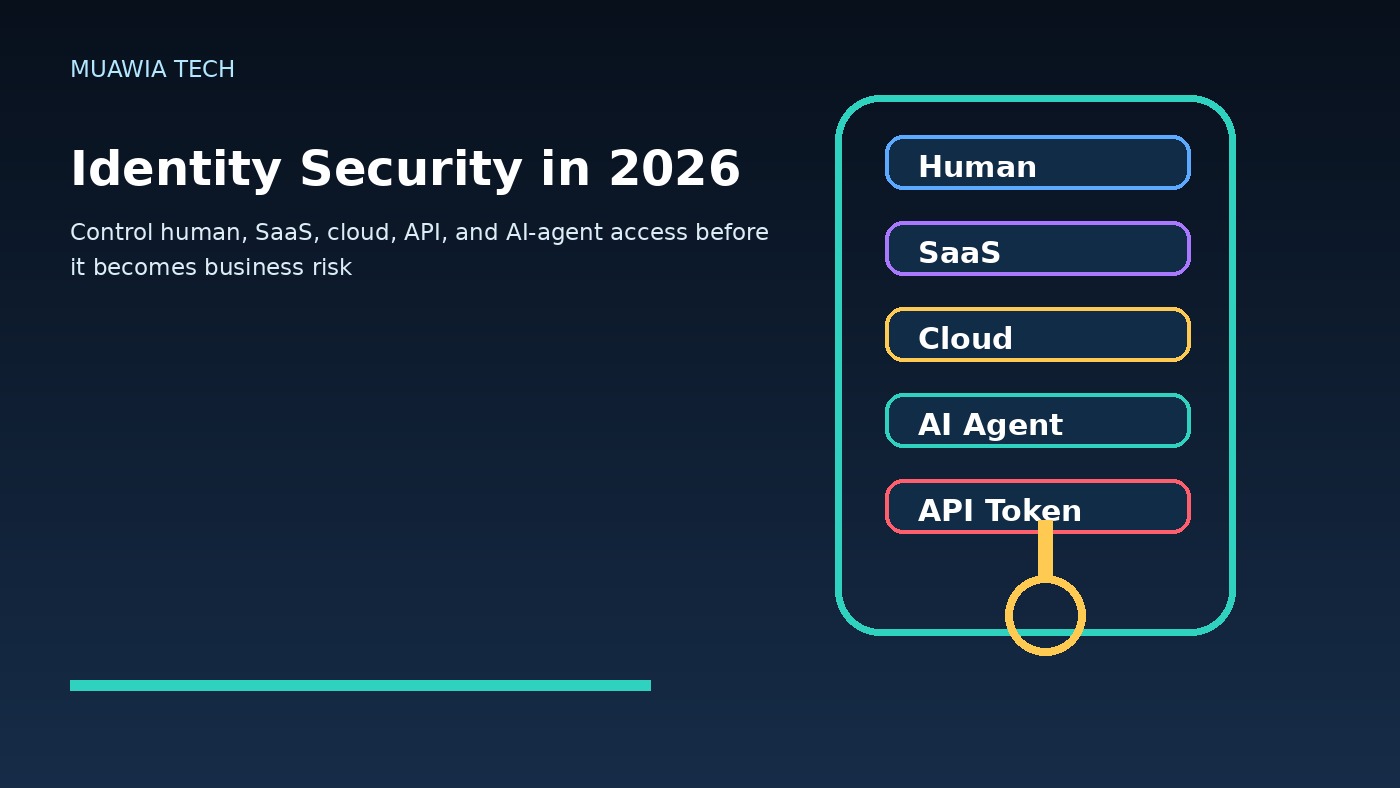
Identity security is the practice of protecting every identity that can access business systems. That includes employees, contractors, administrators, developers, executives, service accounts, workloads, integrations, bots, API tokens, OAuth apps, and increasingly AI agents that act on behalf of a person or process. Each identity has permissions, sessions, devices, credentials, and behavioral patterns. Each can be abused if controls are weak.
Traditional identity programs focused heavily on directories, passwords, and single sign-on. Those foundations still matter, but the operating environment is broader. A typical company may use dozens of SaaS platforms, several cloud accounts, multiple identity providers, code hosting tools, automation platforms, and data services. Access is no longer contained inside one network. It is distributed across vendors and APIs.
Why SaaS, cloud, and AI changed the risk
SaaS platforms made it easy for teams to connect tools without waiting for infrastructure projects. Cloud platforms made it easy for engineers to create powerful roles and services in minutes. AI tools now add another layer because they may connect to documents, tickets, code, customer conversations, analytics, or email. The productivity gain is real, but every integration expands the identity attack surface.
The risk is not only that a human user is compromised. A connected app can keep access after the employee who approved it forgets about it. A service account can retain administrator permissions because an old deployment needed them once. A cloud role can allow cross-account access that nobody reviews. An AI agent can inherit broad permissions from a workspace and perform actions faster than a human would notice.
The main identity security failure patterns
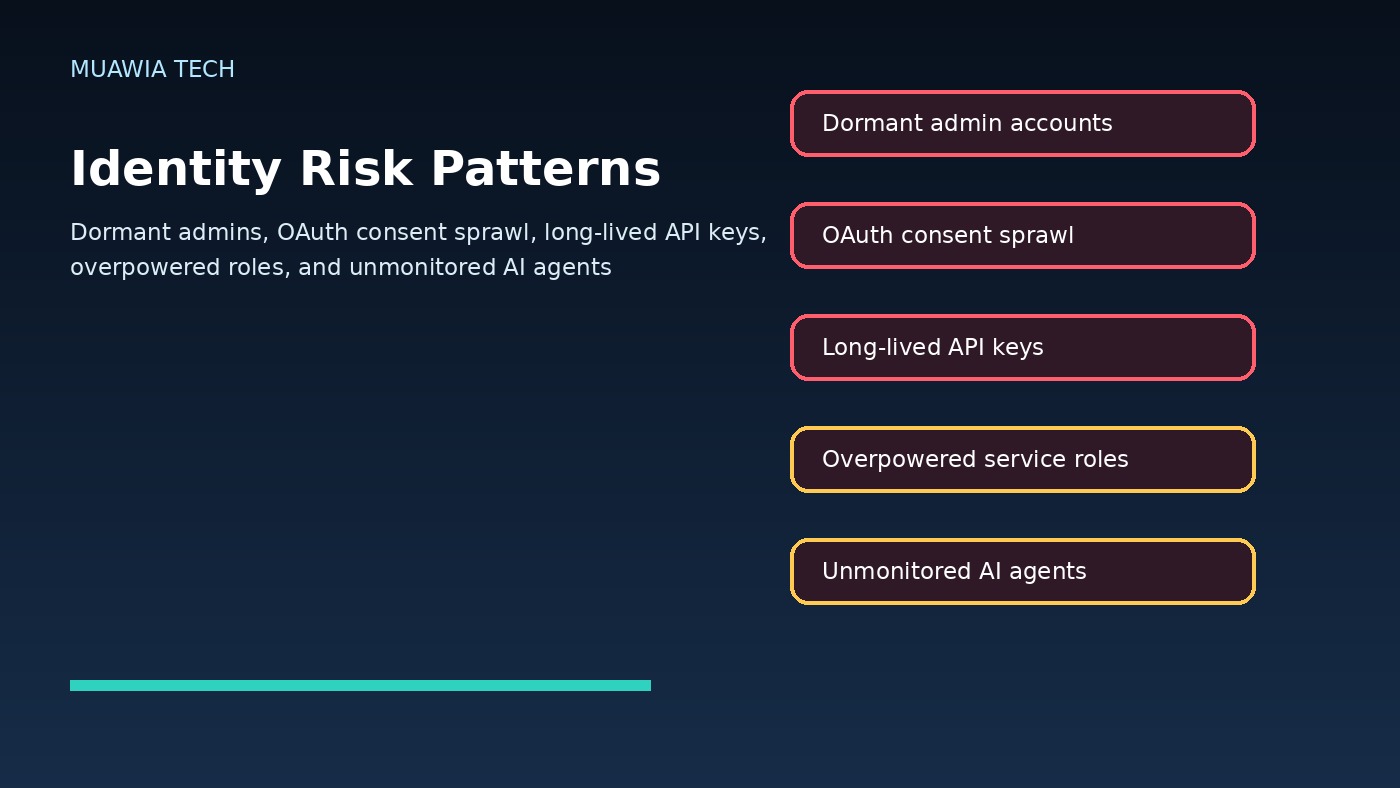
Most identity incidents follow repeatable patterns. One pattern is standing privilege: users or service accounts keep powerful access all the time, even if they need it only occasionally. Another is identity sprawl: many accounts, apps, keys, and roles exist without clear ownership. A third is weak lifecycle management: people leave teams, vendors finish projects, projects end, but access remains active.
OAuth consent sprawl is another common problem. Employees connect third-party apps to mailboxes, drives, calendars, or productivity platforms. Some are legitimate, but others request more access than they need. If security teams cannot see and review those grants, a risky app can become a quiet data path. Long-lived API keys create similar exposure because they often sit in scripts, laptops, repositories, and CI systems with limited monitoring.
Start with identity inventory
The first step is to know what identities exist. Build an inventory that includes human users, groups, privileged roles, SaaS apps, OAuth grants, cloud identities, service accounts, API keys, automation tokens, and AI agents. For each identity, capture owner, purpose, system, permission level, last activity, authentication method, and review status. The goal is not paperwork. The goal is to find identities that are powerful, unused, unknown, or unmanaged.
Inventory should be automated where possible. Identity providers, SaaS admin APIs, cloud IAM APIs, code hosting platforms, endpoint tools, and security logs can all provide useful signals. Manual spreadsheets become stale quickly. A useful identity inventory should answer practical questions: which accounts are inactive, which apps have access to sensitive data, which roles can change production systems, and which service identities have no owner?
Make privileged access temporary
Standing administrator access is one of the biggest identity security risks. If an attacker compromises an account that always has administrator rights, the business has little time to react. A safer model is just-in-time access. Users request elevated permissions when needed, approvals are recorded, access expires automatically, and sensitive actions are logged. This limits the damage window while still allowing legitimate work.
Temporary access should apply to cloud consoles, identity provider administration, SaaS administration, production databases, code repositories, and security tooling. Emergency access can still exist, but it should be tightly controlled, monitored, and tested. The point is not to block administrators. The point is to make powerful access visible, intentional, and short-lived.
Protect non-human identities
Non-human identities are often the weakest part of an access program. Service accounts, workload roles, CI/CD tokens, integration accounts, and API keys may have broad access and little human accountability. They also rarely use multi-factor authentication because they are not people. That means their security depends on scope, rotation, storage, monitoring, and ownership.
Businesses should remove unused keys, shorten token lifetimes, prefer managed workload identity where supported, store secrets in approved vaults, and avoid sharing credentials across systems. Every service identity should have a named owner and a clear purpose. If nobody can explain why an integration account needs administrator rights, it should not have them.
Review SaaS app permissions
SaaS identity security requires more than single sign-on. Administrators should review which third-party apps are connected, what scopes they requested, who approved them, and whether they still need access. High-risk scopes include reading mail, exporting files, managing users, modifying calendars, accessing source code, or reading customer records.
A good review process separates safe productivity integrations from risky or abandoned apps. It also creates a path for teams to request new integrations without bypassing security. If users feel that security only says no, they will find workarounds. If the process is fast, clear, and risk-based, teams are more likely to cooperate.
Connect identity security to cloud posture
Cloud security posture and identity security are connected. A misconfigured storage bucket is dangerous, but an overpowered cloud identity can create that exposure repeatedly. A vulnerable workload is risky, but a stolen deployment token may let an attacker change the workload directly. Cloud posture programs should therefore examine identity paths, not only configuration findings.
Useful cloud identity checks include administrator role assignments, cross-account trust, unused roles, public access combined with sensitive permissions, service accounts with broad data access, and roles that can disable logging or encryption. Prioritize findings that combine privilege, sensitive data, internet exposure, and weak monitoring.
Prepare for AI agents and delegated access
AI agents introduce a new identity governance challenge. When an agent can read documents, create tickets, write code, send messages, query databases, or call APIs, it needs an access model. Businesses should know which human or process the agent represents, what tools it can use, what data it can read, what actions require approval, and how activity is logged.
The safest approach is least privilege with explicit tool boundaries. Agents should not inherit all access from a broad administrator account. Sensitive actions should require confirmation, high-risk data should be restricted, and logs should show both the agent action and the delegated user or workflow. As AI automation grows, agent identity governance will become a normal part of enterprise security.
Monitor sessions and behavior
Authentication is only the start. Businesses also need to monitor sessions and behavior. Useful signals include impossible travel, new device or location, unusual download volume, mass sharing, privilege changes, consent to a new app, creation of a long-lived key, disabled logging, or access to systems outside a user’s normal pattern. These signals help detect account takeover and insider risk earlier.
Monitoring should be tied to response. If a risky session appears, the team should be able to revoke tokens, reset credentials, suspend app grants, disable keys, and remove permissions quickly. Identity security is strongest when detection and containment are built into the same process.
Build a practical identity security roadmap
A realistic roadmap starts with the highest-value controls. First, enforce strong authentication for human users, especially administrators. Second, inventory privileged users, SaaS apps, cloud roles, and service accounts. Third, remove inactive accounts and unused grants. Fourth, reduce standing administrator access and introduce temporary elevation for sensitive systems. Fifth, review non-human identities and rotate or replace long-lived keys.
Next, connect identity signals to security operations. Route high-risk alerts to the right team, create owner-based remediation workflows, and measure how long risky access remains open. Finally, expand governance to AI agents and automation platforms before they become unmanaged shadow infrastructure.
Metrics leaders should track
Leadership should see identity risk trends. Useful metrics include privileged accounts, dormant administrators, unreviewed SaaS apps, sensitive OAuth grants, long-lived API keys, service identities without owners, high-risk exceptions, access-removal time after role changes, and privileged actions covered by logging.
The trend is more important than a perfect score. Are unused privileges decreasing? Are risky SaaS apps being reviewed faster? Are temporary access workflows replacing standing admin rights? These metrics show whether identity security is becoming an operating habit.
FAQ
Is identity security the same as IAM?
No. IAM is a foundation for managing accounts and permissions. Identity security is broader because it includes visibility, risk analysis, privilege reduction, monitoring, SaaS app governance, non-human identities, and response.
What is the first identity security control to improve?
Start with privileged access. Identify administrator accounts, require strong authentication, remove unused access, and reduce standing privilege for the systems that matter most.
Why are non-human identities risky?
They often use API keys, tokens, roles, or secrets rather than interactive login. If they are over-permissioned, unmanaged, or long-lived, attackers can use them quietly and at scale.
How should businesses handle AI agent access?
Give agents scoped permissions, define what actions require approval, log their activity, and map each agent to an accountable owner or workflow. Do not let agents inherit broad administrator access by default.
Conclusion
Identity security in 2026 is about controlling every access path across people, SaaS apps, cloud roles, service accounts, API tokens, and AI agents. Businesses that build accurate inventory, temporary privilege, SaaS app review, non-human identity governance, and strong monitoring can reduce the access paths attackers rely on most. The goal is not to make work harder. The goal is to make access intentional, limited, visible, and fast to revoke when risk appears.